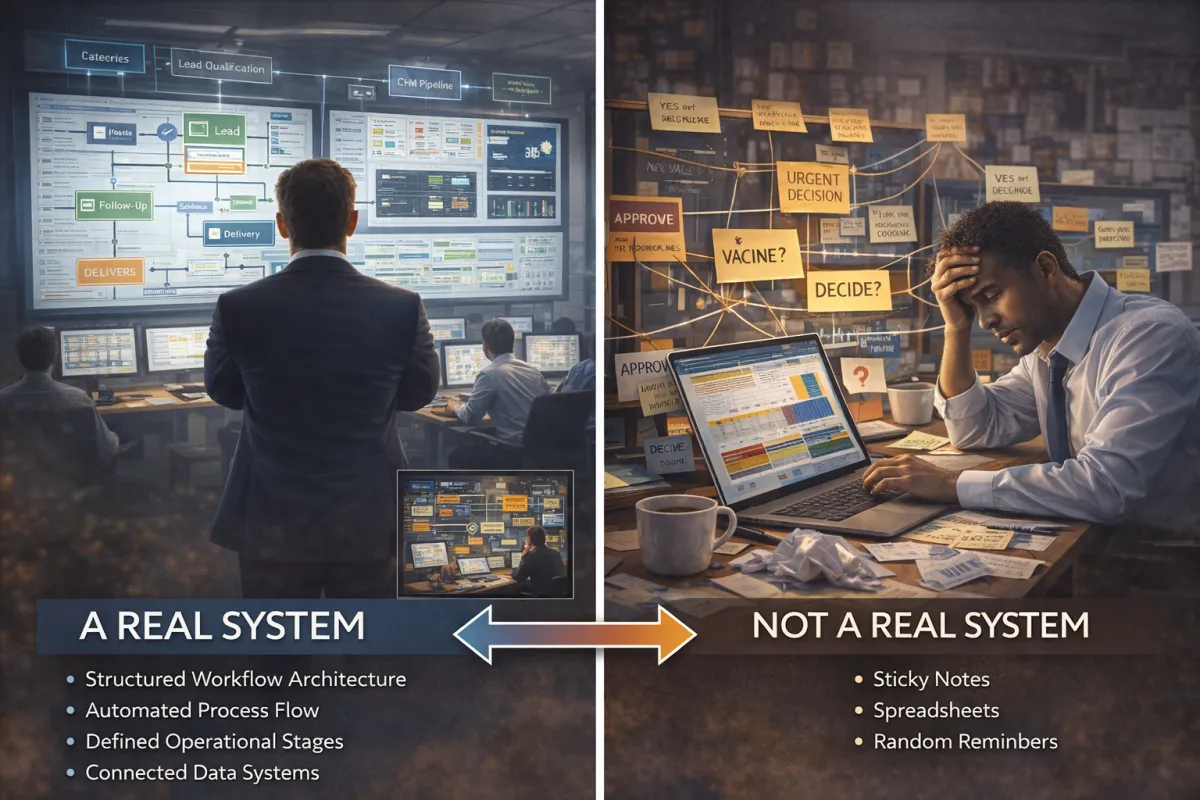
What a Real System Is (And What People Mistake for One)
Why organized effort is often mistaken for a real system
Why organized effort is often mistaken for a real system
People use the word system constantly.
“I built a system.”
“We need better systems.”
“Our system isn’t working.”
But most of the time, what they’re pointing to isn’t a system.
Its effort is arranged neatly.
And the difference matters — because effort can hold things together for a while.
A system holds things together without you.
The Result Most People Live With
Work gets done.
Tasks are completed.
Messages get answered.
Customers get served.
From the outside, it looks functional.
But remove one person — or even one afternoon of attention — and everything slows.
Not because people are careless.
Because continuity depends on memory.
That’s the clue.
The Pattern That Reveals It
Watch what happens when something unusual occurs.
A special request.
An exception.
A slightly different situation.
Everything pauses.
People ask what to do.
Someone interprets.
Someone decides.
Then things move again.
If progress requires interpretation every time conditions change, you’re not watching a system.
You’re watching coordination.
What People Commonly Call a System
Several things get mistaken for systems.
Checklists.
Documentation.
Software.
Automation.
All useful.
Nonesufficient.
A checklist tells someone what to remember.
Software stores information.
Automation repeats instructions.
But each still depends on someone deciding what applies in the moment.
That’s assistance — not structure.
The Irony
The more organized a team becomes without structure, the more fragile it gets.
Because order exists only while attention exists.
People become the connection layer.
So, when they’re busy, tired, or absent, the organization resets to confusion.
Effort was maintaining the appearance of stability.
Not stability itself.
What a System Quietly Does
Before defining it, notice a behaviour.
In a real system, the same input produces the same outcome — without supervision.
Not perfect outcomes.
Predictable ones.
Predictability is the signal.
Not speed.
Not neatness.
Not activity.
Consistency.
The Definition
A system is a structure that determines behaviour in advance.
Not a reminder.
Not a tool.
Not a person’s expertise.
A structure.
It removes the need for interpretation in normal situations.
People still work inside it.
But they no longer have to figure out how the work connects each time.
Why This Matters
Without systems, organizations scale effort.
With systems, organizations scale reliability.
That’swhy adding people alone increases coordination cost.
And adding tools alone increases noise.
Until structure exists, growth multiplies variation.
After structure exists, growth multiplies output.
Final Answer to the Core Question
A real system isn’t something that helps people perform work.
It’s something that determine show work behaves before people touch it.
If operations depend on attention, memory, or constant clarification, you don’t have a system yet.
You have organized effort.
And organized effort cannot scale predictably.
Scale by design — not by chance.