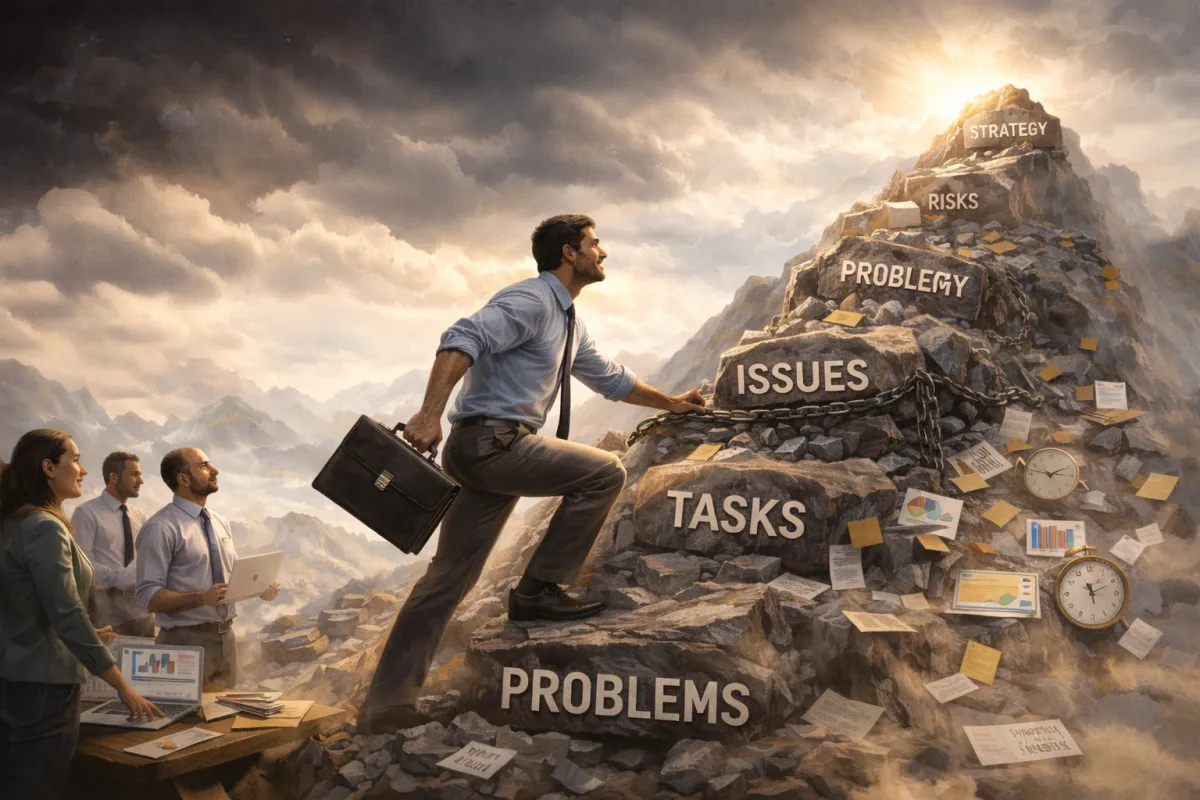
Why Execution Feels Harder the More Responsible You Become
Why growing responsibility quietly increases execution friction, and what that really means
There’s a quiet moment that shows up for people who carry real responsibility.
It’s not burnout.
It’s not fear.
It’s not laziness.
It’s the moment when doing the work feels heavier than it used to—even though you’re more capable than you’ve ever been.
And that moment comes with a dangerous question:
“What’s wrong with me?”
Nothing.
That’s the point.
The Weight Isn’t You
Execution doesn’t get harder because you forgot how to work.
It gets harder because the load changed.
Early on, effort is linear.
You do something.
You get a result.
Feedback is fast.
Correction is simple.
Responsibility adds layers.
Now your actions affect other people.
Decisions cascade.
Mistakes echo.
Every move has downstream consequences.
The work didn’t break.
The environment changed.
Why It Feels Like You’re Slowing Down
Here’s the pattern most people miss.
As responsibility increases, decision density increases faster than skill.
More inputs.
More dependencies.
More exceptions.
More people waiting.
Execution starts to feel like friction—not because you’re weaker, but because the system around you is noisier.
Ironically, the more competent you become, the less visible your progress feels.
That’s when self-blame sneaks in.
The Silent Trap of Self-Blame
High performers don’t quit when things are hard.
They assume they are the variable.
So, when execution slows, they internalize it.
They push harder.
They optimize themselves.
They add tools.
They stack processes.
And the weight increases again.
Not because they chose poorly— but because they’re compensating for something structural with personal effort.
The Problem Isn’t Motivation
This is where most advice goes wrong.
You don’t need to want it more.
You don’t need to hustle harder.
You don’t need another framework.
Those are upstream solutions.
They help people start.
They don’t help people sustain.
By the time execution feels heavy, motivation isn’t the issue.
Containment is.
What’s Actually Breaking
Here’s the name for what you’re experiencing:
System strain.
It happens when growth outpaces structure.
Your responsibilities expanded.
Your architecture didn’t.
So, your mind became the buffer.
And the human brain is the worst place to store scale.
Why This Feels Personal (ButIsn’t)
Systems fail quietly.
They don’t announce themselves.
They just leak energy.
So, the only feedback you feel is internal:
Mental fatigue
Indecision
Slower follow-through
A constant sense of “almost caught up”
That’s not a character flaw.
That’s a system asking to be named.
The Irony
The more disciplined you are,
the longer you’ll tolerate a broken structure.
You’ll carry it.
Patch it.
Power through it.
Until execution feels heavier than it should.
That’s not weakness.
That’s responsibility without containment.
The Real Answer
Execution feels harder because responsibility multiplies complexity.
And complexity without architecture always collapses inward—onto the person.
You’re not broken.
The load is structural.
And structural problems don’t require more effort.
They require design.
If this resonated, hold onto it.
Clarity comes before momentum.