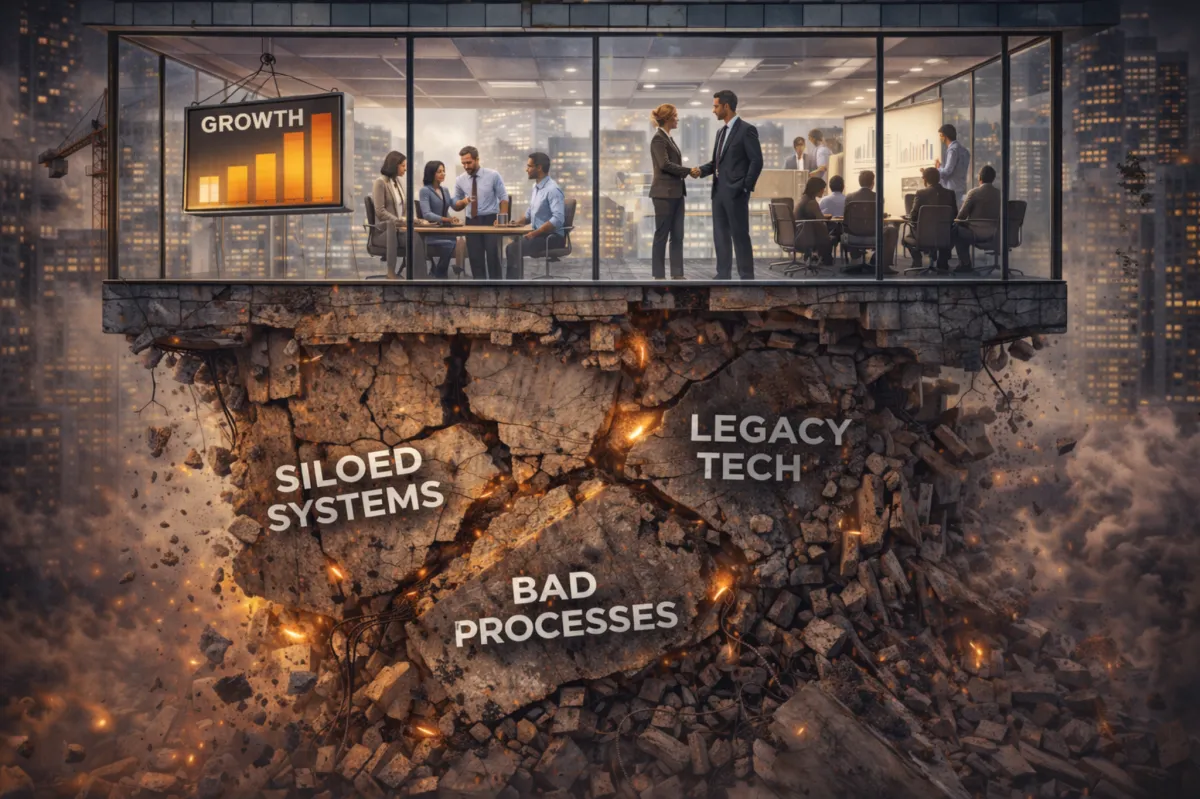
Growth Doesn’t Break Business, Weak Foundations Do
Why growth exposes structural weaknesses instead of creating them
Most people don’t actually fear growth.
They fear what growth does to their business.
More customers sound good.
More revenue sounds good.
But underneath that is a quiet concern:
“What if everything falls apart when it finally works?”
That concern is usually accurate.
Just not for the reason people think.
The Result You’re Anticipating
Businesses rarely collapse during slow periods.
They collapse during momentum.
More leads arrive.
More conversations happen.
More commitments are made.
And suddenly, things that worked yesterday stop working today.
Responses get delayed.
Quality slips.
Decisions stall.
Growth didn’t feel like success.
It felt like pressure.
The Pattern That Repeats Everywhere
Here’s what shows up across industries.
A business struggles to grow.
Then growth finally comes.
For a moment, everything feels validated.
Then instability appears.
Not randomly.
Predictably.
Delivery slows.
Communication fragments.
The owner becomes the bottleneck.
People call this scaling problems.
But notice the timing.
Nothing broke until volume increased.
That’s the clue.
The Irony of Chasing More
Effort is usually applied in the wrong direction.
When instability shows up, businesses push harder.
More marketing.
More hiring.
More tools.
They try to outrun the pressure.
But pressure doesn’t come from growth itself.
Pressure comes from weight meeting a structure not designed to carry it.
Why This Feels Like a Personal Limit
This is where doubt enters.
Owners assume they’re overwhelmed because they lack leadership ability.
Or discipline.
Or time management.
So, they work longer hours.
They hold tighter control.
They stay involved in everything.
And the system becomes dependent on their presence.
That’s not leadership.
That’s load bearing.
What Growth Quietly Requires
Before naming the issue, notice something simple.
Growth doesn’t add new problems.
It reveals hidden ones.
Small volume hides weaknesses.
Large volume exposes them.
The business didn’t suddenly become disorganized.
It always was, volume just removed the buffer.
The Missing Layer
People call this scaling.
But scalingisn’t speed.
Scaling is stability under increased demand.
The missing piece isastructure that can absorb load without changingbehaviour.
That has a name:
Foundation.
Not motivation.
Not tactics.
Foundation is the part of a business that keeps outcomes consistent when pressure rises.
Without it, growth converts variation into chaos.
Why Hustle Makes It Worse
Working harder delays the signal.
You personally compensate for the weakness.
You catch mistakes.
Clarify instructions.
Reconnect communication.
So,the business appears functional—
but only while you’re present.
Growth doesn’t break the business.
It removes your ability to manually hold it together.
Final Answer to the Core Question
Growth doesn’t destroy companies.
It exposes whether the foundation can carry weight.
If growth feels dangerous, it isn’t because success is unstable.
It’s because the structure underneath hasn’t been designed for scale.
Growth is pressure.
And pressure only breaks what wasn’t built to hold it.
Scale by design, not by chance.