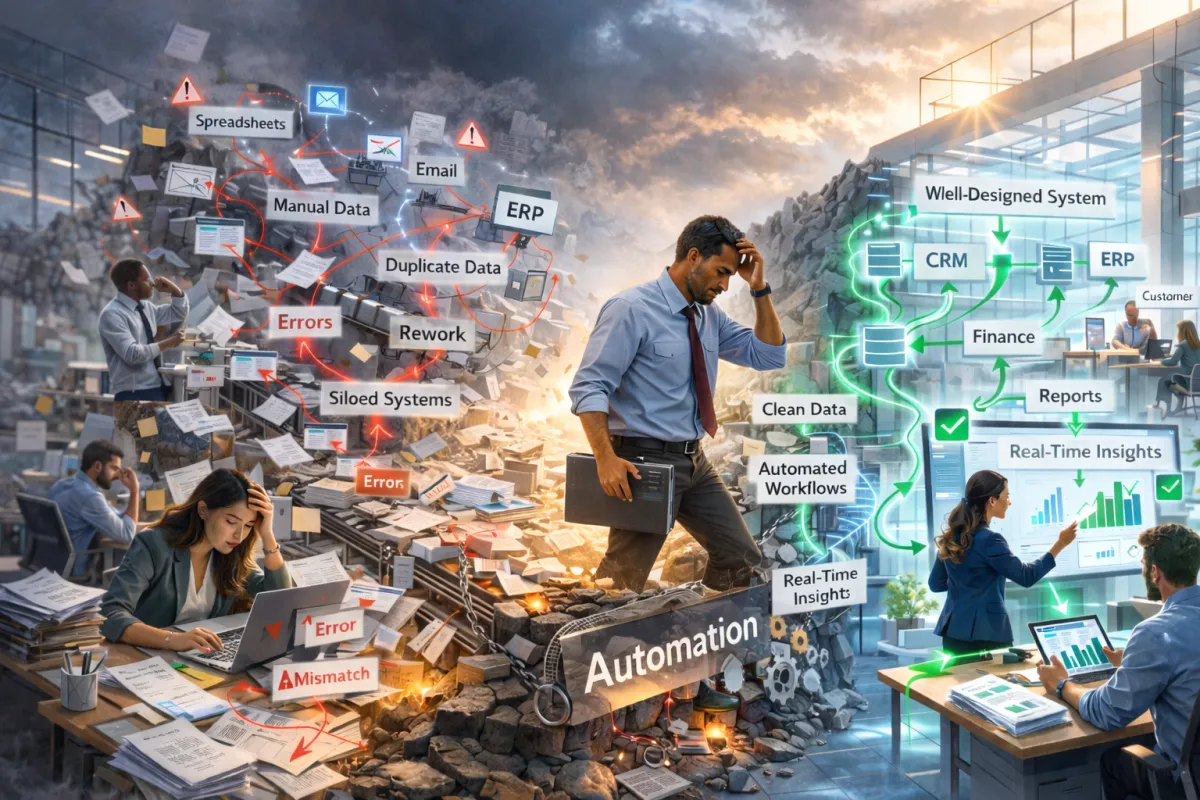
Why Automation Makes Bad Systems Feel Worse
When speed multiplies confusion instead of reducing it
Automation doesn’t fix messy systems.
It exposes them.
And when it does, the result isn’t relief.
It’s frustration.
That’s why so many people walk away from automation tools feeling disappointed, confused, or quietly embarrassed for believing the promise.
Not because automation failed.
Because it worked exactly as designed.
The Result You’re Experiencing
You didn’t expect miracles.
You expected things to feel lighter.
Faster.
Cleaner.
More under control.
Instead, everything sped up—including the problems.
Errors multiplied.
Messages went out at the wrong time.
Leads got touched too much… or not at all.
And instead of saving time, you found yourself babysitting the system.
That’s the signal.
The Pattern Most People Miss
When automation goes wrong, the story is always the same.
The tool gets blamed.
“It’s buggy.”
“It’s too complex.”
“It’s not as smart as advertised.”
But notice the pattern.
The same confusion shows up across platforms.
Across tools.
Across vendors.
Different software.
Same disappointment.
That’s not coincidence.
The Irony of Automation
Automation doesn’t create behaviour.
It accelerates what’s already there.
If a process is clean, automation amplifies clarity.
If a process is messy, automation amplifies chaos.
Ironically, the more powerful the tool, the worse the experience feels—because there’s nothing buffering the mistakes anymore.
Speed removes forgiveness.
Why This Feels Like a You Problem
Here’s where self-doubt creeps in.
You start wondering if you “set it up wrong.”
If you missed a step.
If you’re just not technical enough.
So, you watch more tutorials.
Add more rules.
Stack more logic.
And the system gets heavier.
Not because you’re incompetent—but because you’re automating uncertainty.
What Automation Actually Assumes
Before I name the real issue, notice this:
Every automation tool assumes something.
It assumes decisions are already made.
It assumes handoffs are already defined.
It assumes exceptions are already understood.
Automation doesn’t decide what should happen.
It only decides how fast it happens.
The Concept Comes Late for a Reason
Most people hear this term too early, so they dismiss it.
But now it will land.
The missing piece isn’t better automation.
It’s system integrity.
That’s the condition where a system behaves predictably because its structure is sound not because someone is constantly correcting it.
Without integrity, automation becomes a megaphone for disorder.
Why More AI Won’t Save It
This is where hype does real damage.
AI is positioned as a thinking layer.
But AI doesn’t replace clarity.
It requires it.
When inputs are vague, AI guesses.
When rules are unclear, AI improvises.
When priorities conflict, AI amplifies the conflict faster than any human could.
That’s not intelligence.
That’s acceleration without containment.
The Quiet Correction
Automation isn’t step one.
It’s not even step two.
It’s a multiplier.
And multipliers don’t fix problems.
They reveal them.
Which is why premature automation feels like failure—and well-timed automation feels like relief.
Final Answer to the Core Question
Automation makes bad systems feel worse because it removes the friction that was hiding the problem.
It doesn’t create chaos.
It exposes it.
Soif automation disappointed you, it doesn’t mean you chose the wrong tool.
It means the system wasn’t ready to be multiplied.
And that’s not a technology problem.
That’s a design problem.
Scale by design — not by chance.